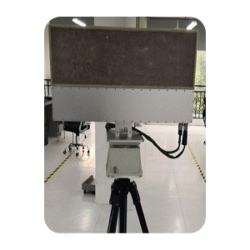
SF-X60 Low-Altitude Early-Warning Radar
Overview

The LT-X60 phased-array UAV surveillance radar is a key low-altitude monitoring system featuring unattended operation, high reliability, low cost, and a phased-array architecture.

It is designed for low-altitude (0 m – 3000 m), small-RCS (0.01–10 m²), and slow-speed (3 km/h – 400 km/h) targets.

A single radar unit can detect and locate low-altitude flying targets within a near-field range of 0.1–50 km.

When networked, multiple radar nodes can provide low-altitude surveillance of critical areas such as urban regions, borders, and air corridors.

By deploying a network of phased-array radars, the system can perform real-time detection, tracking, and localization of multiple targets across a wide area.

Compared with traditional low-altitude monitoring radar solutions, this system offers lower cost, smaller size, easier deployment, and higher reliability.

Each radar node can be co-located with a mobile communication base station, utilizing the station’s power supply and cooling system, while exchanging radar detection data through the base station’s fiber-optic network interface.

The primary function of this radar is to provide networked coverage of key regions and to perform search and surveillance of low-altitude targets within the 0–3000 m altitude layer.

Main Features

This system is capable of all-weather operation and offers long detection range, accurate real-time positioning, strong target acquisition capability, and rapid, precise interference response.

Key features include:

  • Phased-array architecture with high sensitivity and stable performance.
  • Strong resistance to active and passive interference.
  • High resolution and measurement accuracy, enabling multi-radar surveillance networking.
  • Excellent clutter-suppression performance in complex environments.
  • Addresses the global technical challenge of detecting low-altitude, small-RCS, slow-speed targets.
  • Equipped with an elevation adjustment mechanism, allowing antenna tilt adjustment for deployment in diverse terrain environments.
  • Overcomes target-masking issues caused by background reflections in complex environments, enabling reliable detection of low-slow-small targets.
  • Solves multi-target selection, tracking, and identification challenges in cluttered environments.
  • Supports electro-optical fusion, enabling integrated operation with optical cameras.
PARAMETER VALUE
Frequency Band X-band, 9 GHz – 10 GHz
Waveform Linear frequency-modulated pulse
Antenna Waveguide slot array
Scanning Method Elevation electronic (phase) scanning + azimuth mechanical scanning
Coverage Scenario Suitable for single-radar, full-airspace coverage scenarios
Dimensions 1500 × 1310 × 340 mm
Weight 180 kg
Display Range 0.075 – 60 km
Azimuth Coverage 0° – 360° scanning
Elevation Coverage 0° – 30°
Measured Dimensions Range / Azimuth / Elevation / Velocity
Radar Detection Power Range
(Pd = 0.90, Pfa = 1×10⁻⁶)
≥ 60 km (RCS = 2 m²)
Detection Accuracy Range Accuracy: ≤ 8 m
Azimuth Accuracy: ≤ 0.5°
Elevation Accuracy: ≤ 0.5°
Resolution Range Resolution: ≤ 15 m
Azimuth Resolution: ≤ 2°
Elevation Resolution: ≤ 1.5°
Velocity Detection Range: ±0.8 m/s ~ ±20 m/s
Data Processing Capability Tracking Mode: TWS / Continuous Tracking
Number of Trackable Targets: ≥ 200
Map Overlay: Supports map & nautical chart overlay
Data Rate: ≤ 10 s
Anti-Jamming Capability Strong resistance to interference;
Supports frequency hopping & agile frequency switching;
≥ 20 operating frequencies
Continuous Operating Time 24 hours continuous operation
Power Supply AC 220 V
Total Power Consumption Rated 6000 W
Deployment Time Setup: ≤ 30 minutes
Teardown: ≤ 30 minutes
MTBF ≥ 1000 hours
MTTR ≤ 0.36 hours