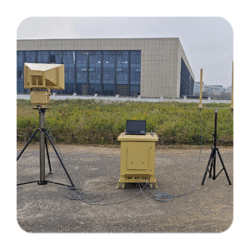
Ultra-Long-Range Full-Band Navigation Spoofing System
System Overview

The ultra-long-range full-band navigation spoofing system is designed and manufactured in accordance with top international military standards. It is specially engineered for harsh operating conditions such as high temperature, high altitude, strong corrosion, and severe vibration, ensuring stable and long-term operation.

The system is capable of conducting spoofing operations against GPS, Beidou, GLONASS, Galileo global navigation satellite systems, as well as Japan’s QZSS and India’s IRNSS regional navigation systems.

It can spoof all civilian satellite navigation signals within these constellations, with:

Omnidirectional spoofing distance ≥ 30 km

Directional spoofing distance ≥ 50 km

The system supports panel operation, web-terminal operation, and C2 system integration. It includes comprehensive self-diagnostic functions that allow each module and key component to perform self-checks and provide real-time status monitoring.

It also offers full-function integration interfaces to facilitate access to other system platforms.

The system features strong environmental adaptability and electromagnetic compatibility. It has passed MIL-STD-810H and MIL-STD-461G testing and certification. It is resistant to rain, dust, fog, high altitude, high temperature, humidity, and salt-spray corrosion, enabling operation in severe environments and complex electromagnetic conditions.

Mean Time to Recovery (MTR): ≤ 30 minutes

Mean Time Between Failures (MTBF): ≥ 5000 hours

System Spoofing and Interference Capability

GNSS Signals Capable of Being Spoofed

The system is capable of spoofing various civilian satellite navigation signals of the global navigation satellite systems GPS, Beidou, GLONASS, Galileo, as well as Japan’s QZSS and India’s IRNSS (NavIC) regional navigation satellite systems. The spoofable signals are listed below:

No Constellation Frequency Band Signal Type
1 BDS B1 B1I
2 B1C
3 B2 B2I
4 B2a
5 B2b
6 B2a+b
7 B3 B3I
8 GPS L1 L1CA
9 L2 L2CA
10 L5 L5I
11 Glonass I–L1 L1CA
12 I–L2 L2CA
13 II–L1 L1CA
14 II–L2 L2CA
15 II–L3 L3
16 II–L5 L5
17 Galileo E1 E1B
18 E1C
19 E5 E5a
20 E5b
21 E6 E6
22 IRNSS (NavIC) L5 L5
23 QZSS L1 L1C/A
24 L1 L1C
25 L2 L2C
26 L5 L5
Coverage Range

For airspace below 500 m altitude:

Omnidirectional navigation spoofing distance ≥ 30 km

Directional navigation spoofing distance ≥ 50 km

For high-altitude airspace above 1500 m:

Directional navigation spoofing distance ≥ 100 km

Interference Capability Against Military GNSS Receivers

Although the system cannot perform actual spoofing against military GNSS receivers, it can effectively interfere with military satellite navigation equipment that uses encrypted codes, such as GPS P-code, M-code, BeiDou encrypted signals, etc.

The system can suppress these military signals, causing the equipment to be unable to perform real-time positioning and forcing it to stop outputting location data.

Interference Capability Against GNSS-Inertial Integrated Navigation

Because the system has a relatively wide coverage range, it can interfere with navigation equipment that relies on the combination of satellite navigation and inertial navigation.

Since the system denies the satellite positioning corrections necessary for inertial navigation error compensation, it significantly reduces the accuracy of such integrated navigation systems.

Adaptability in a Spoofed GNSS Environment

When satellite navigation signals are interfered with or spoofed by third parties, the system can still operate properly.

By using network time service, star ephemeris data, and other auxiliary methods, the system maintains stable operation and is not affected by interference or spoofing.

Deployment Adaptability

Whether the system is deployed on a fixed platform or a mobile platform, it can operate stably in both scenarios.

Methods for Breaking Through GNSS Anti-Jamming Technologies

Civil GNSS Receiver + CRPA Anti-Jamming Antenna Scenario

For civil GNSS systems equipped with CRPA (Controlled Reception Pattern Antennas) Anti-Jam antennas:

The system can impose a relatively good suppression effect on conventional jamming.

However, its suppression against Spoofer signals is weak.

By increasing the transmitted power, it is still possible to achieve satisfactory interference effectiveness.

Military GNSS Receiver + CRPA Anti-Jam Scenario

Although military encrypted devices cannot be spoofed, the Spoofing signal and military encrypted GNSS signals have high spectral similarity, enabling the system to achieve relatively good interference effects.

The interference performance is significantly better than noise jamming, barrage jamming, sweep jamming, etc.

Deploying multiple Spoofers in a circular formation, transmitting signals from multiple directions simultaneously, achieves a better suppression effect.

In general, three devices distributed circumferentially can achieve good results.

Anti-Spoofing Receiver + CRPA Anti-Jam Scenario

If the user deploys both Anti-Spoofing receivers and CRPA Anti-Jam antennas, the system can significantly suppress both Anti-Jamming filtering and Anti-Spoofing identification.

Using multiple Spoofers deployed in a circular formation, transmitting Spoofing signals from multiple directions simultaneously, can still effectively suppress such advanced receivers.

Typically, two devices in a circular configuration can achieve good results.

Typical Application Scenarios
  • Navigation Spoofing Against UAVs
    The system is capable of spoofing UAVs that rely on satellite navigation positioning, which may cause the UAV to lose control and crash.
  • Navigation Spoofing Against Unmanned Surface Vessels (USV)
    The system can spoof unmanned vessels that rely on satellite navigation, enabling operators to redirect or manipulate the vessel into circling or deviating from its intended route.
  • Navigation Spoofing Against Maritime Vessels
    The system can spoof vessels navigating at sea, preventing them from acquiring accurate positioning or causing them to obtain incorrect coordinates, resulting in loss of direction and navigational deviation.
  • Construction of GNSS-Denied Zones
    By using omnidirectional or directional spoofing modes, the system can establish GNSS-denied environments within designated areas.
System Performance Specifications
Parameter Performance Specification
Spoofing Signals All civilian satellite navigation frequency bands and modulation types of GPS, BDS, GLONASS, Galileo, QZSS, IRNSS
Signal Generation Method Synthesized Generation
Spoofing Modes Fixed-point Spoofing, Directional Spoofing, Circular Spoofing, Tracking Spoofing
Activation Time ≤ 5 s
Spoofing Distance Airspace below 500 m:
Omnidirectional spoofing: ≥ 30 km
Directional spoofing: ≥ 50 km
Spoofing Distance Airspace above 1500 m:
Directional spoofing: ≥ 100 km
Coverage Airspace Directional spoofing: Horizontal ≤ 30°, Vertical ≤ 90°
Omnidirectional spoofing: Horizontal 360°, Vertical ≥ 60° (6 dB beamwidth)
Supports simultaneous omnidirectional and directional transmission
Transmit Power 100 W (power amplifier output)
Antenna Gain Directional antenna gain: ≥ 15 dBi
Omnidirectional antenna gain: ≥ 3 dBi
Directional Beamwidth Beamwidth: Horizontal ≤ 30°
Side-lobe level: Horizontal ≤ –25 dB
Back-lobe level: ≤ –30 dBi
Self-Diagnostic Capability Real-time display of operational status of each module and key functional components; automatic fault localization to module level
Protection Rating IP67
Environmental Standard MIL-STD-810H
Operating Temperature –20°C to +65°C
Storage Temperature –20°C to +71°C
Solar Radiation 1120 W/m², 49°C
Blowing Rain MIL-STD-810H Method 506.6 Procedure I Blowing Rain
Drip Rain MIL-STD-810H Method 506.6 Procedure III Rain Drip
Humidity MIL-STD-810H Method 507.6 Procedure I Humidity
Salt Fog MIL-STD-810H Method 509.7 Salt Fog
Blowing Sand/Dust MIL-STD-810H Method 510.7 Procedure II Blowing Sand/Dust
Vibration MIL-STD-810H Method 514.8 Procedure I Category 4 Vibration
Compliance Standard MIL-STD-461G
EMI/EMC CE102
CE106
CS101
CS114
CS115
CS116
RE102
RS103
Deployment / Teardown Time ≤ 10 min, 2 personnel
Reliability MTBF: ≥ 5000 h
MTTR: ≤ 30 min